Spiders

December - 'old December's bareness everywhere!' *

* from Sonnet 97, William Shakespeare

Please remember to access the video footage in this Blogpost through the Liddells website: www.liddells.co.uk

1st December

The camera focussed on plentiful acorns on the path below the apiary is capturing much foraging. Unfortunately the quality of the footage isn’t great, however you will gather a sense of how much activity there is. The Pigeon in the second video seems to swallow an acorn whole; in the third, the pigeon on the right appears to change its mind and spits out an acorn.

2nd December

More clearing from the Ash felling. Clare decided it was like a giant game of Spillikins. She found a couple of particularly well-named examples of Jelly ear fungus: Auricularia auricula-judae

One of the feeders at the hide has been set upon by a determined creature. John and Clare suspect a squirrel, although the indentations could be from a corvid’s beak.

Ears

Spillikins

Feeder damage

5th December

The buck kid adds to the list of acorn foragers.

Today Clare noticed a different fungus while clearing, sawing and stacking Ash branches. This one is possibly Barnacle lichen, although she is unsure about the identification. Relaxing in the hide after the work, Clare counted twelve Goldfinches - the most seen together at the hide in a very long while and seven managed to use the nyjer seed feeders at the same time. Clare was delighted that a flock of Fieldfares and Redwings came briefly into the Hawthorn in front of the hide. They didn’t stay long however one Redwing perched for long enough for Clare to attempt a photograph. While the bird was easy to see with the naked eye, Clare found it much harder to locate it using her phone camera.

Maybe Barnacle lichen

Spot the Redwing (Spot is not the bird’s name)

6th December

Assorted birds forage around and on the acorns: female and male Blackbirds, Pheasants (lots), Robin, Blue tit, Coal tit, Chaffinches, Fieldfares, Redwing. Even a hare has a sniff around. The footage of the hare is the clearest, so here it is followed by footage of a Redwing. You can just detect the flash of red under its wing and hear the whistling call as it flies off.

7th December

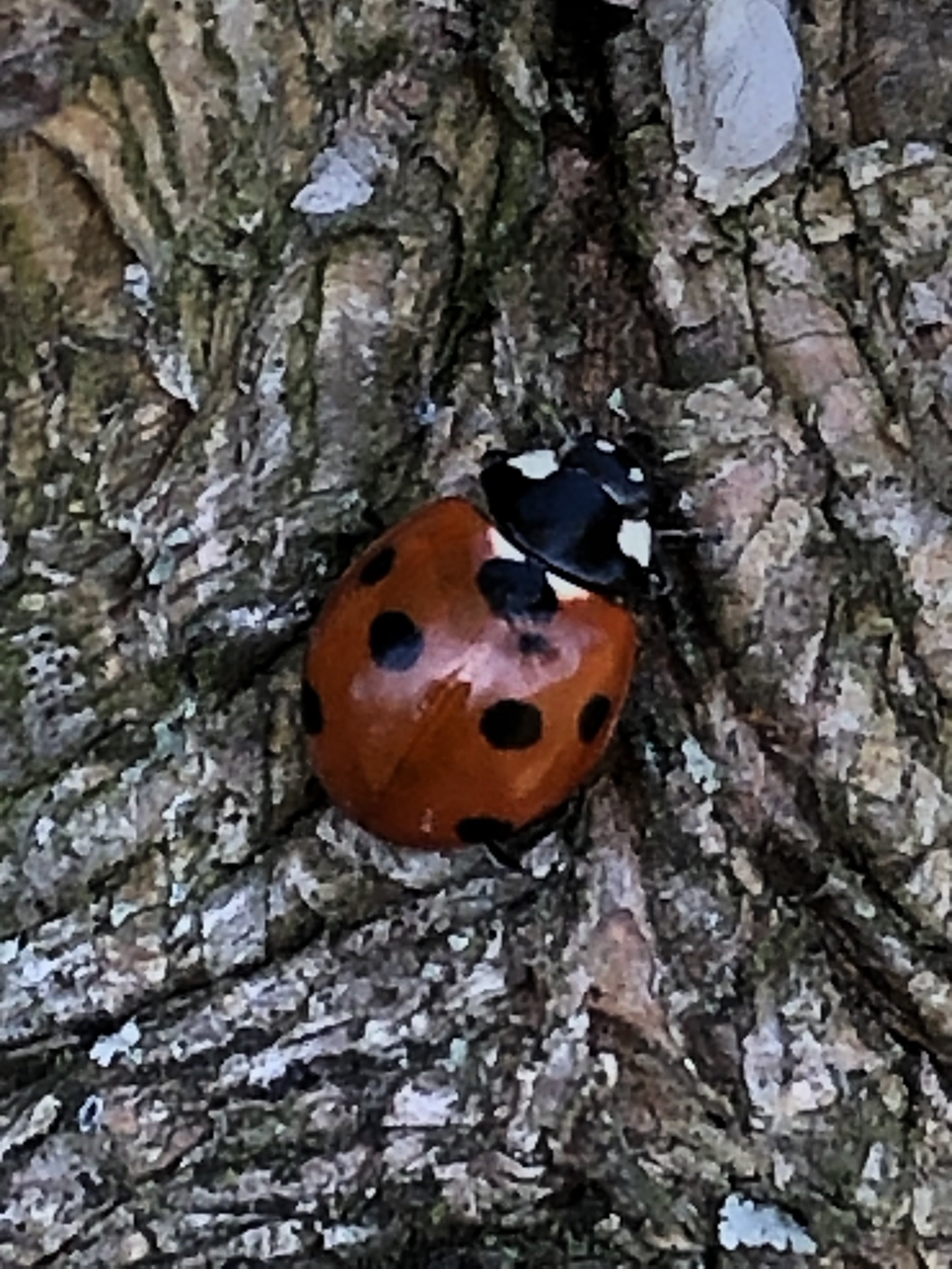
Rewards for Ash clearing today included a patch of Yellow Brain fungus, some more and more Barnacly fungus, a 7 spot ladybird and a satisfying stack of logs.

Winter fu-uel

Another hare or the same hare has a hunt through the leaf litter.

9th December

The buck kid - note the buttons where his antlers are beginning to develop, spent over 15 minutes foraging on the path, wandered off then returned 15 minutes later for another 3 minutes. Here are a couple of clips - you can see the thickness of his winter coat.

10th December

There seem to be more Pigeons around Liddells than in previous years. Here a group forage together on the path below the apiary. The most common collective noun for Pigeons is ‘flock’ with ‘flight’ used when the birds are on the wing. Racing Pigeons can be called a ‘kit’ or a ‘loft’, while numbers of urban Pigeons have been called a ‘dropping’ or a ‘plague’. Clare prefers her term for the ones on the path.

11th - 16th December

John and Clare decided to move the trail camera from the path to the Top Strip. The last of the videos from the path showed the button buck returning (not included here) and a Jay collecting more acorns, probably to store them and then forget where. More Oaks for Liddells if that proves to be the case.

17th - 24th December

The camera at the end of the Orchard has decided that Clare’s seventy-second birthday must be fixed in time. Whatever reprogramming Clare and John operate on the camera, the camera has a mind of its own. The camera captures many movements in and out of the Pit Wood, most of which in the last few days have been hares. Here are a couple apparently practising for Spring activities.

The camera newly positioned in the Top Strip has mainly captured clips of sheep. An adventurous, or possibly hungry group has broken out of the Hayfield in search of food. When Clare went to collect the discs she had to do some impromptu shepherding as three sheep had got their heads stuck in the sheep-proof fence. Does this mean the fence is or isn’t effective? One of the animals required Clare to think about the manipulations of childbirth as she twisted the head to free one ear then the other. Not one of the sheep said a word of thanks.

The incorrect dates on these clips are due to human error - forgetting to reset the date after adding new batteries. Again.

The presence of the sheep in the Top Strip possible accounts for the alarm shown by one of the two deer - its caudal patch is prominently erect.

Twelve Wild Days

Clare decided to take up the Northumberland Wildlife’s Trust to engage with nature in some way or another over the twelve days of Christmas. Here is the result of her challenge thus far:

25th December - the first day

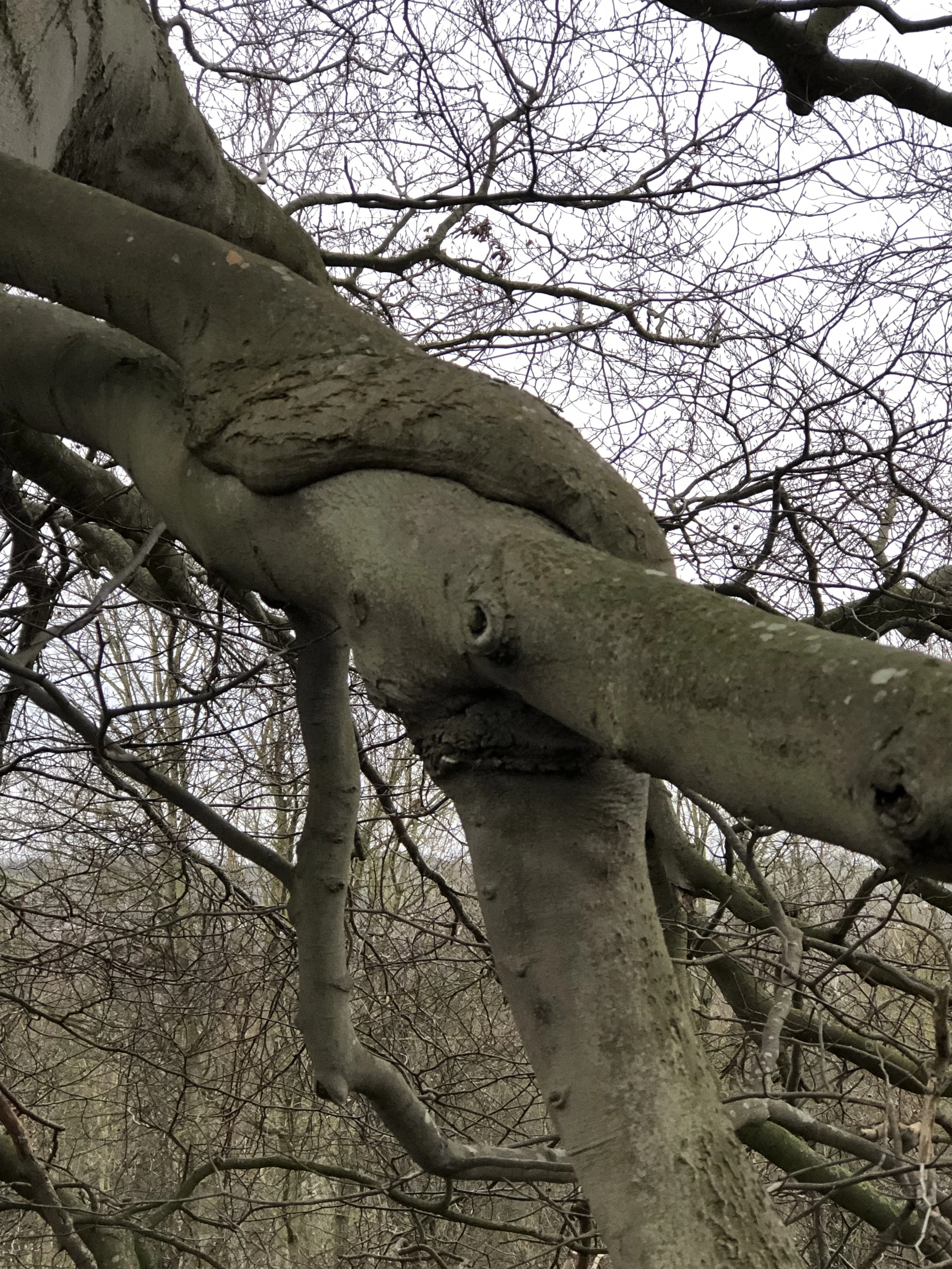
A serendipitous encounter with a friend in her car to start the process and an example of inosculation.

26th December - the second day

Hazel catkins are in abundance in the Top Strip.

27th December - the third day

A walk through local woods enabled Clare to adopt the role of nature teacher to Hal and Juno - she pointed out the tiny pine cones at the end of the Scots Pine twig, evidence of squirrel nibbling on the pine cone and the berries on the ivy which are food for Blackbirds, Thrushes, Blackcaps, Starlings, and Woodpigeons, Redwings and Waxwings.

Clare read the most recent RSPB and Roebuck (Northumberland Wildfife Trust) magazines. She especially enjoyed the articles on Holly and mosses in Roebuck.

28th December - the fourth day

A surprise encounter with a small elephant and a great example of pareidolia. As Hal pointed out, the elephant certainly has a trunk. Clare also noticed a cow with a crumpled horn and hoped it hasn’t been tossing any dogs. The cow is a Longhorn.

Clare identified 21 different bird species on her walk today: Buzzard, Kestrel, Pheasant, Carrion Crow, Rook, Magpie, Jay, Blackbird, Robin, Dunnock, House Sparrow, Wren, Coal Tit, Blue Tit, Great Tit, Fieldfare, Redwing, Common Gull, Black-headed Gull, Wood Pigeon and a single Goldcrest. One hedge was quite noisy with House Sparrows. The Pigeons on a wire nearby look quite organised in comparison.

29th December - the fifth day

Clare saw a charm of Goldfinches and then heard and saw a small flock of Nuthatches.

30th December - the sixth day

A walk with Jane B (her longest since a recent knee op) and the delights were many. First a Little Egret, then a male and female Goosander, then, oh joy, a Kingfisher came and perched on a small branch close by. On the return route the Little Egret reappeared as did the Kingfisher and another male Goosander. Neither Jane nor Clare had any wish to sound greedy, however they did remark that they hadn’t seen a Dipper. At the end of the walk they went a bit further to have a look at the river from the road bridge and two Dippers dipped before flying off into the undergrowth on the bank. Seconds later and Jane and Clare would have missed them.

Clare had looked earlier in the day at Uncommon Ground: A Word-lover’s Guide to the British Landscape by Dominick Tyler and had noticed the word ‘daddock’. It is apparently a dialect word for rotten wood. ‘Daddock implies a dry, crumbling rot that might …dessicate standing wood to provide tinder. Some of the old dialect dictionaries give ‘daddock’ as a synonym for ‘touchwood’, a word derived from the Old French ‘toucher’ meaning ‘set fire’, hence ‘touch-paper’. Every day a school day on the Blog.

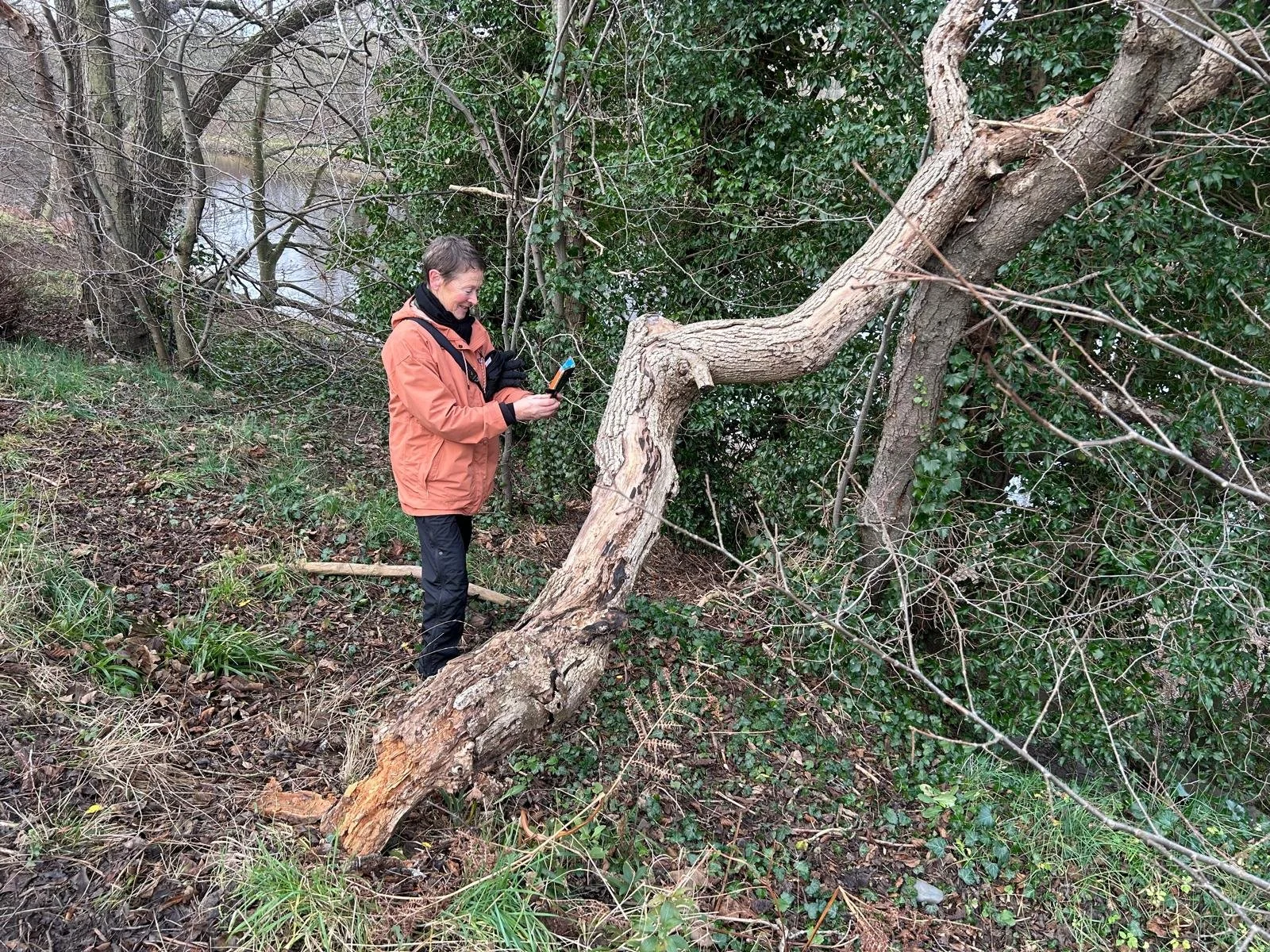
Below is the daddock Clare spotted, the black fungus growing on it - King Alfred’s Cakes Daldinia concentrica, which are round, black and hard; they are named for their resemblance to burnt cakes, they make excellent firelighters - and Jane’s photo of Clare capturing the fungus on camera. Clare finds it pleasing that both the fungus and its rotten wood host are good for fire-lighting.

31st December - the seventh day

Ahead of a family visit to Liddells Clare discovered the entrance to a rabbit burrow very close to a Field Maple and then another hole although this time made by a Labyrinth Spider in the Shepherd’s Hut.

More Twelve Wild Days will follow in the New Year. Meanwhile an excellent way to have an encounter with nature, if you haven't already discovered it, is to have a read of Chris Wren’s magnificent TrogTrogBlog: https://trogtrogblog.blogspot.com/ He has published several end-of-the-year favourites recently and offers wonderful footage of otters, stoats, weasels and even a polecat, birds incuding the elusive Water Rail and more besides.

At this time of the year, the funnel webs in our gardens are normally the work of Labyrinth spiders.  Labyrinths are common, shy little creatures, and being a dull grey-brown colour they go largely unnoticed.  It's only when they start building webs that they draw attention to themselves.


At one end of the web there's a funnel shaped retreat. In fact the web is really quite a magical piece of defensive architecture, designed to protect the spiders eggs.

An end of the year check on the trail cameras showed a hare having a good stretch and the doe chasing off the buck kid in what looks like an unusually forceful manner.

Liddells is a good place to mark the end of the year and a fire for toasting marshmallows is all part of the ritual. Hal, Beth and Juno brought another family with them. As they left Clare hoped they might come again whereupon the younger son replied, “Who wouldn’t want to?” A heart-warming end to the year.

Wishing all readers a Happy New Year and thanks for supporting the Blog.

September - a quiet month

There are very few videos to see this month, however a reminder that to see whatever there are, you have to access the Blog through the website: www.liddells.co.uk

What’s That Bird?

What is making the high pitched ‘tzee’ sound in the Scrub?

A postscript to August. Clare shared the photo of the Common Blue butterfly she had seen by Pond Maggiore at the end of the month with Tim. His response was, ‘Your fine photo shows pale blue spots on the outer edge of the wings between the veins. My literature does not describe this, it must be a Liddells subspecies.’ Here it is again so you can see the spots which Tim noticed. Polyommatus icarus Liddellus maybe?

8th - 9th September

Clare was amused to find a spider had made its way into her hair as she worked. The creature is a Crowned Orbweaver, commonly called a Garden Spider, although Clare prefers to think she was being awarded a crown for her work. It is probably more at home on the stone than in Clare’s hair.

John and Clare went to Edinburgh to see the Andy Goldsworthy retrospective at the Scottish National Gallery. Among all the wondrous sights, Clare enjoyed Goldsworth’s creative way with Foxglove flowers. An artistic challenge for Liddells maybe?

While Clare busied herself persuading as many of the local residents as possible to vote for the town cinema in the first ever Cinema of the Year awards, John worked steadily on with routine maintenance, finishing the new fencing round the Shepherd’s Hut (now properly sheep proof), bringing logs up from felling and working on the new gate on the Hayfield. The wildlife seemed to be on ‘routine maintenance’ too with nothing of particular interest on the trail cameras.

21st September

The voting closed and Clare hot-footed it up to Liddells to celebrate. She noticed that along with many fruiting plants, the Hawthorns and Elderberries were heavily laden. A few Branched Burrweed plants have reappeared in Pond Maggiore. They offer good habitat for emerging damsel- and dragonfly nymphs, however need thinning every few years. The pond needs some clearing as the rush is taking over. Time for Clare to don her waders. Autumn fungi has begun to appear, presenting Clare with her annual identification challenge. She is not planning to eat any of them although remembers being told that all mushrooms are edible. Some just once.

Branched burrweed

Fly agaric - the easiest to identify

Clare was amused to notice another pellet, probably from a pigeon’s crop, on the new gate on the Hayfield. Recent rain had caused the grain to sprout.

Tim sent photos of the sunset.

22nd September

Clare and John added a breasting wire outside the boundary wall that the cattle have knocked down recently. They are hoping this prevents further damage. While John hammered in posts, Clare collected up rubble from the wall repair and added it to the path coming down through the Scrub to help level the path horizontally. John had brought up spare rubble from some garden work at home, so Clare added that too. It should making coming down on the quad bike safer.

The wire doesn’t show up well on a photo so here is the start of it.

Clare then decided that carting rubble was insufficient work for the day so set about digging out the Roadside Pond before there was more rain. She was pleased with the result and very muddy. Her reward came in the form of four Small Coppers on the Mint beside Pond Maggiore (two proved to be camera shy), a Southern Hawker (frustratingly never still but caught fleetingly in a video) and another Common Blue, although this one doesn’t have the spots that Tim noticed on the August butterfly.

While she was walking around, Clare decided to note all the plants still in flower. She listed Red Clover, Purple Loosestrife, Yarrow, Buttercup, Dandelion, Mint, Common Catsear, Rosebay Willowherb, Michaelmas Daisy, Tormentil, Eyebright, Creeping Thistle, Mugwort.

23rd - 30th September

Some videos to end the month. A hare spent 12 minutes grooming in the Pit Wood. One of the videos is included just to use the caption ‘Washing your hare’.

Another clip showing a bird intent on attacking the camera - Clare decided it was trying to intrude into proceedings being held in camera.

One of the kids shows how its coat is still very spotty; a doe is seen in close up showing what beautiful creatures deer are; a doe followed by a kid squeaking show how they are both losing their summer coats; and in the cat versus squirrel battle, the squirrel seems to be the victor.

John has completed the fastenings on the new gate ready for the sheep. He discovered the apples in the Orchard had ripened. This is the first fruit from the earliest fruit tree planting several years ago.

And finally - John came home delighted to have finished the mowing for the year and even more delighted to have backed the flail mower into the storage container seamlessly on the first try! Sadly there is no photographic record of this huge achievement.

The last of the summer flowers - Rosebay Willowherb

Fruit, if not exactly fruitful

What’s that Bird? - Tree Creeper

July - 'wetter summers might prevent hay being cut' - fortunately not this year

To view the video footage in this Blog post go to www.liddells.co.uk and click on Blog.

1st July

John and Clare are keen to see how the three does and the six kids they have between them share the space on Liddells. Here the doe and singleton make their way through the Scrub.

2nd July

Clare reckoned she had removed all the Hogweed from the Meadow. Whether she has or not will be seen in due course. She completed a second butterfly transect; Meadow Browns and Ringlets were in evidence but not in great numbers. Following Tim’s route up to the Meadow from the north, Clare noticed a patch of Monkey Flower Erythranthe guttata which she had never seen on Liddells before. The plant is typically found growing in water margins and wetlands so it is not in its usual habitat, however it is very welcome, as is the Spot-winged Drone Fly foraging on Marsh Valerian.

The doe with twins is captured on the north edge Pit Wood and the singleton shows its growing independence in the centre of the Pit Wood.

3rd July

It is always a treat to see the deer and their kids in video footage, however it is also good to see evidence of other wild animals on Liddells. A fox and a badger put in an appearance in the Scrub.

5th July

Meadow Browns are around most dry days now.

A hare provides evidence that it is not just roe deer that are a threat to tree growth, however it is good to see the hares in the trail camera footage as at this time of year they are hidden in the long grass for much of the time.

7th July

Clare set about collecting Yellow Rattle seeds from this year’s growth. she bagged over 100gms which is quite a lot of seed. John mowed the path at the west end of the Top Strip for the first time since abandoning weeding as the form of maintenance - the mowing worked well so Clare can strike ‘maintain Top Strip path’ off her to-do list for evermore.

In this year’s dearth of butterflies Clare was pleased to see a Large Skipper on the Greater Knapweed.

8th July

The proximity of the rut is evidenced by the older buck chasing a doe through the Pit Wood and something has disturbed the doe and twins in the same location.

9th July

The twins forage independently in the Scrub and a bit over an hour later are with the doe in the rain in the Pit Wood.

10th July

In the Pit Wood the doe and her single kid provide a charming example of learning by copying.

Later the same day the Scrub camera, albeit with some obstruction on the lens, captures the doe with her triplets.

11th July

The triplets are the last of the kids to demonstrate their independence, caught on camera in the Scrub.

Shortly later the twins bound through the same area.

Ruth completed another ringing session. Her previous session had been very quiet so she was very pleased this time to end up with her highest number of birds yet - 50. She ringed several juvenile Blackcaps and Chiffchaffs, a juvenile Linnet and a pair of Yellowhammers. A good day!

Juvenile Linnet - Ruth said it ‘looked very fresh (wings and tail still growing)’

A Robin ‘starting to look like a Robin’!

Juvenile Yellowhammer 1…

and 2

16th July

Although the new gate on the Meadow has been at cost to a patch of Field Scabious Knautia arvensis, Clare is delighted that a different patch is thriving. Apparently species of scabious were used to treat scabies and many other afflictions of the skin including sores caused by the bubonic plague. The word scabies comes from the Latin scabere 'to scratch'. The plant is also called gipsy rose.The genus Knautia is named after a 17th-century German botanist, Christian Knaut.

Juveniles are often present on the feeders and John was able to photograph a young Goldfinch.

18th July

John decided to reposition one of the cameras on the Hayfield as there was evidence of the deer using the long grass for couching. No deer appeared however there is an amusing clip of a Pheasant staring into the lens. Clare took a photo of the camera so readers can work out where the bird perched. She also remembered that there is a wildflower called Pheasant’s Eye. If readers click on the link, you can decide whether the flower is well named.

19th July

As in previous years the Willow Tits have disappeared through the breeding season, which leaves John and Clare anxious. They were both relieved to see one of the adults at the feeders today. John will take his camera up in the hope of further sightings.

21st July

As the day warmed up Clare noticed quite a few bumblebees around. Here is a Garden Bumblebee making the most of the forage on a Spear Thistle, a honey bee on Creeping Thistle, a pair of Red Soldier Beetles illustrating their nickname (Hogweed Bonking Beetles) and some Ragwort from the Wetland. Many people have heard that Ragwort is poisonous and a threat to horses and cattle and then assiduously pull it up from verges and the like. Horses and cattle will not eat Ragwort in a field; the plant is only poisonous if it is cut into a hay crop and fed to beasts. The plant is a valuable food source for a wide range of insects, in particular the cinnabar moth. John and Clare pull out any they find on the Hayfiled and Meadow, however they leave it in other places.

Clare enjoys seeing honey bees foraging on Liddells and always assumes they are from the Liddells apiary

Bonkers!

The much maligned Ragwort.

23rd - 24th July

An update on the deer. The triplets and the twins have been captured by the Scrub camera. After last month’s first ever (for John) footage of a deer barking, here is another. Expect the third any day…

Tom and Barry had planned to start cutting and making the hay earlier this week then the weather defied the forecast, however today it and the prospect over the next few days was better so Tom cut the Hayfield. Clare is unsure whether it is more stressful not knowing whether the grass can be cut at all or, when it is cut, whether the rain will hold off until the hay is made.

Recently the fat ball feeders in front of the hide have been opened and the fat balls eaten in spite of the feeders allegedly being squirrel proof. John and Clare have tried several methods of securing the lids none of which has proved to be effective for longer than a day or two. Clare set up a camera to see what happened.

25th July

John and Clare are spending a lot of time preparing Liddells for an Open Weekend next month, so while one man (Tom) went to mow, one man (John) took to his strimmer and one woman (Clare) set to work with her sickle and her scythe. John and Clare are making sure the paths are clear ready for visitors. While Clare was walking up through the Scrub she noticed the single Nettle-leaved Bellflower (there has never been more than one) is in flower.

25th - 28th July

It took the squirrel a couple of days to get the lid off. In the process it investigated the nyjer seed feeder as well. The squirrel made four visits/attempts on the first day, four on the second and cracked it on its second visit on the third day. Thereafter it made four further visits that day and two on the next before Clare retrieved the disc. The feeder is now secured with a cable tie - probably easily chewable. The videos below show something of the process and how almost the instant the squirrel is successful and leaves with his trophy, the birds come to the nyjer seed feeder (one of the Willow Tits appears; they seem to vanish during the breeding season so Clare & John are especially pleased to have evidence they are still around). A Wood Pigeon looks bemused by how to get a fat ball even though the top of the feeder is off but then Pigeons seem bemused at the best of times. Clare was told that a way of recognising their call was to hear ‘I don’t know, I don’t’. A juvenile Woodpecker shows its head as it starts to climb the pole.

Later that night in the Scrub the camera catches the height of the rut. The old buck drives the oldest and largest of the does round in a circle through hawthorns. There were three videos. In the first the pair make three circuits; there is a five second gap while the camera regroups and then captures another two circuits and the sounds of a third before the clip finishes. In the third video, five seconds later and not included here, you can hear the doe squeaking then all goes silent. Readers can use their imaginations for what happened next. John says he has read a buck will mate with the youngest does first, so he deduces that this buck will already have mated with the other two does who have Liddells as their home patch. If there is no buck on the home patch, the doe will go and find one and draw it in. Clare commented that there must be different driving circles on Liddells as the Scrub camera has been working and has not recorded any other driving. The rut is propelled by the does, who are monoestrus, coming into oestrus from mid-July. There is thinking that this happens as daylight hours begin to shorten. Apparently the word ‘rut’ is ‘late Middle English: from Old French, from Latin rugitus, from rugire ‘to roar.’’ Red deer stags do indeed roar, however as readers of this Blog know, roe deer bark.

29th July

With no fat balls left, the squirrel has to picnic on pine cones.

Clearing inside a caged Scots Pine, Clare saw a female Nursery Web Spider carrying her egg sac in her fangs.

While John and Clare feed a pile of brash through a chipper, Tom takes a spinning class.

Tom will probably row up the hay tomorrow. It smells gorgeous

The Point of View steps looking chipper after a top up

After John and Clare had left, a juvenile Greater Spotted Woodpecker visited the feeders.

30th July

As expected the squirrel had chewed through the cable tie so there are now carabiner clips on the fat ball feeders. Ha!

Ruth had a personal best with 62 birds in her nets this morning. She said that the warblers were arriving in the nets in small flocks. She listed the juveniles - 9 Chiffchaffs, 9 Siskins, 6 Willow Warblers, 6 Robins, 5 Blackcaps, 4 Bullfinch, 3 Goldfinch, 3 Blackbirds, 2 Wrens, 2 Blue Tits, 1 Goldcrest, 1 Dunnock and 1 Great Tit. It sounds like an alternative version of the Twelve Days of Christmas.

Yesterday Clare had found a Broad-leaved Helleborine where she had not found one before however she had forgotten to take a photograph. Today she went looking for more and found only about a half dozen plants in total, far fewer than when she and Mel first discovered the plants on Liddells two years ago. (Mel will probably complete a wildflower survey any day so watch next month’s Blog post for a numbers update.) On the way Clare noticed a Red Admiral and a Comma both with folded wings and blending into the bark, high on an Oak. Her attempts to take a photo of them together came to a full stop when the Comma flew off. It was the only Comma Clare has seen this year.

She also looked for the Betony in the Pit Wood and found a colony of about twenty plants still thriving; the Bittersweet nearby them was also increasing in its spread.

Betony Stachyis officinalis commonly known as Common Hedgenettle, Purple Betony, Wood Betony, Bishopwort, or Bishop’s wort. Historically, it was planted in churchyards to prevent activity by ghosts.

In dyeing the plant makes chartreuse on wool with alum mordant.

Betony was also an ingredient of “Pistoja powder,” an old herbal medicine remedy for arthritis, gout, and tension headaches. It was also claimed to be effective against snake and dog bites, and was believed to be a cure for drunkenness.

Bittersweet Solanum dulcamara also known as Woody Nightshade. The berries are toxic; the leaves smell of burnt rubber when crushed.

At the Big Pond Clare watched Common Blue and Emerald Damselflies, a male Common Darter and the impressive blue helicopter that is the male Common Hawker. Clare apologises for the poor quality of the photos, at the time she was more concerned with not falling into the pond than with sharp focus; also she didn’t have her glasses; and dragon and damselflies won’t keep still for long! She had more success filming a Raft spider weaving its web above the surface of the pond. ‘The chocolate-brown raft spider inhabits bogs and ponds. It can be spotted sitting near the water, its legs touching the surface. When it feels the vibrations of potential prey, it rushes out to catch it, floating like a raft…Raft spiders will also swim underwater, often diving beneath the surface when threatened.’ According to the Wildlife Trust website, these spiders are ‘widespread but scarce.’ (wildlifetrusts.org)

On her way up to the Hayfield Clare saw what she first thought were ladybirds on one or two of the Willows in Sylvia’s Avenue, however on closer inspection they proved to be galls. Identification, even with the help of the British Plant Gall Society (who knew?) still proved difficult, however they are possibly Aceria iteina a mite that causes galls on Salix species.

The Scrub camera recorded the singleton kid with a dragonfly in the foreground - a reminder that dragonflies often use trees for shelter.

31st July

Tom rowed up the hay this morning. This afternoon, while Clare was working on path clearing, she heard the welcome sound of a tractor. The month has ended balefully. Ten bales this year, fewer than before however John and Clare are very relieved to have the work completed. Huge votes of gratitude to Tom and Barry for making time to help us.

Hip, hip, hoo hay!!